

STARTING IN MEXICO / 2027 GUIDE
5 keys to starting a business in Mexico in 2027

You have a business idea, potential customers and a target launch date. Then the questions start: Which legal entity should I choose? Who should own the company? What is DORS? When can I invoice? Starting a business in Mexico in 2027 begins with putting those decisions in order.
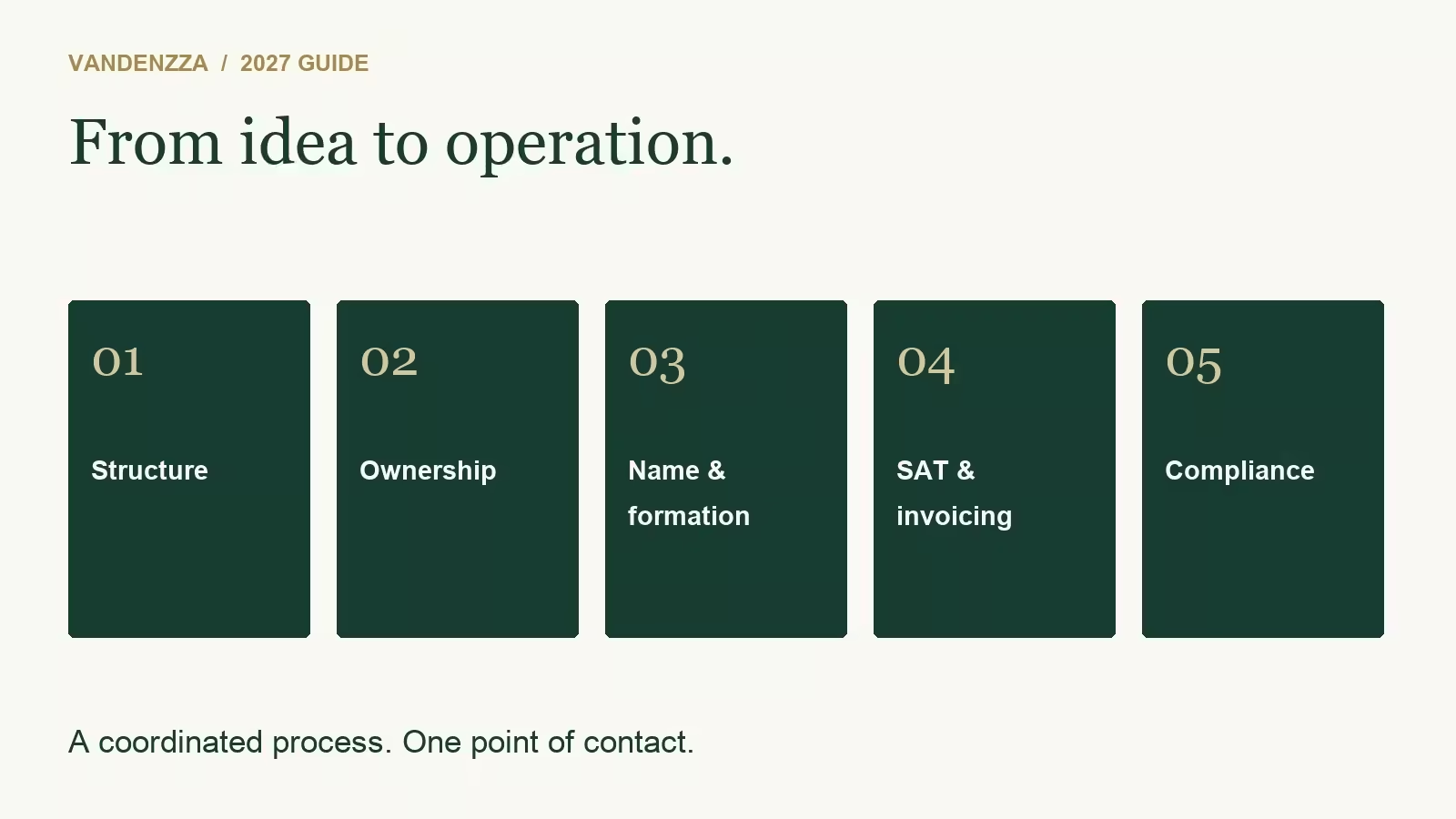
This guide covers five essentials for moving from an idea to a formal operation. Vandenzza connects incorporation support through legal and notarial professionals with accounting, tax and payroll services, giving you one point of contact from the start.
1. Choose a structure that fits your business
Before requesting incorporation documents, explain what you will sell, who will invest, whether you will hire and how you expect to grow. Not every business needs a company at the outset: operating as an individual may be an option in some cases. The right approach depends on liability, contracts, ownership and operating needs.
Your legal form and your tax regime are separate decisions. One organizes the company and its owners; the other determines how it is taxed. Selecting a corporation does not automatically select the most suitable tax treatment.
| Option | What to consider |
|---|---|
| S. de R.L. de C.V. | Uses membership interests and allows up to 50 members. Review the rules for admitting or replacing members. |
| S.A. de C.V. | Has share capital and requires at least two shareholders. Management and oversight must be defined. |
| S.A.S. | Can be incorporated electronically by one or more individuals who meet the conditions. Restrictions and an annual revenue ceiling apply; verify the ceiling for the relevant year. |
See Mexico’s General Law of Commercial Companies and the official S.A.S. overview (Spanish).
If you plan to raise investment, use a specialized structure or bring in foreign owners, explain that goal early. A simple arrangement today may need changes as your business develops.
Your next step: request a structure review before signing. Book a call with Vandenzza and tell us what you are building.
2. Agree on ownership and how decisions will be made
Choosing business partners also means agreeing on how you will work together. Before incorporation, document contributions, ownership percentages, responsibilities and exit arrangements. Avoid adding someone solely to meet a headcount requirement without understanding the consequences.
- Ownership: who contributes cash or assets and what interest they receive.
- Management: who runs the business and which decisions need approval.
- Representation: who can sign contracts or handle filings, with what authority.
- Continuity: what happens if an owner leaves, sells their interest or disagrees with the others.
Two founders may invest equally but have different roles. Decide whether both must approve borrowing or whether one may enter contracts independently. Clear percentages alone do not determine who can bind the company.
The company must also identify the individuals who ultimately control or benefit from it and keep their information up to date. This is its beneficial ownership file, known in Mexico as beneficiario controlador. PRODECON explains the obligation (Spanish).
Vandenzza coordinates the review with legal support to align your arrangements with the business. Message us to request a proposal.
3. Obtain DORS authorization and incorporate
DORS commonly refers to the authorization to use a denominación o razón social, the company’s legal name. Mexico’s Ministry of Economy grants this authorization. Prepare several name options.
The online application requires the applicant’s e.firma. The official procedure lists a response time of up to two business days and authorization validity of 180 calendar days. A response can include rejection or conditions. Check the official name authorization procedure.
The incorporation document is then prepared and signed before the relevant authorized public official, except for special routes such as the S.A.S. It establishes the business activities, capital, owners and operating rules. Registration in the Public Registry of Commerce and the notice of use of the authorized name also need attention. See the official guidance on traditional company formation and the name-use notice.
Your legal name and your brand are different. Company-name authorization does not register a trademark. If you will invest in a brand, also review protection through Mexico’s Industrial Property Institute, IMPI.
Ask for professional fees, notarial costs, government charges and follow-on services to be itemized. This makes proposals easier to compare and shows what remains before launch.
4. Register with SAT and prepare your first invoice
Signing the incorporation document completes one stage. To progress to tax operations, you need the company’s RFC tax ID, its e.firma and the invoicing arrangements that apply. SAT is Mexico’s Tax Administration Service; its registration is separate from the company-name authorization.
For company registration, prepare the incorporation document, proof of tax address, the legal representative’s identification and authority, and the owners’ tax information as required. Foreign owners can involve specific conditions. Review the official RFC registration requirements.
- A prepared representative: sufficient authority and an active personal e.firma are required to obtain the company’s e.firma. See SAT guidance.
- Activity and tax regime: these must reflect your business and eligibility, rather than a generic recommendation.
- Invoicing: prepare the digital seal certificate and the system for issuing CFDI electronic invoices. The e.firma and the digital seal serve different purposes. See the digital seal procedure.
- Tax mailbox: activate and verify contact details where required, and assign someone to monitor notices. See SAT’s tax mailbox guidance.
Prepare your corporate bank account in parallel. Banks review their own files and may request additional documents. Confirm that you can issue invoices and receive funds before committing to a customer payment date.
5. Plan your first month of operations, not just incorporation
A company needs a compliance routine. Decide who supplies invoices and bank statements, who reviews accounting records and who approves payments. A shared calendar makes responsibilities visible.
- Accounting and tax: maintain records and supporting documents, and make the filings and payments applicable to your regime and activity. Low sales do not automatically remove every filing obligation. See the statutory accounting framework.
- Employees: review contracts, payroll, employer registration, worker enrollment, social security and local obligations when hiring. See IMSS employer registration for companies.
- Permits: confirm municipal, state and sector requirements before opening premises or starting a regulated activity.
- Corporate records: retain books, minutes and resolutions, and update powers, ownership records and required information when changes occur.
Foreign investment: review sector restrictions and duties before the National Registry of Foreign Investment (RNIE). Where applicable, registration is due within 40 business days of the foreign investment entering the business. Check the RNIE deadlines. Foreign documents may require apostille or legalization and translation, depending on their origin and use.
Explore our accounting, tax and payroll services. We can define a scope around the support your business needs, with communication in English and Spanish.
How long does it take to set up a company in Mexico?
For planning purposes, allow approximately four to eight weeks for a traditional company with complete documents and a straightforward operation. This is an organizational estimate, not an official deadline or a Vandenzza commitment. Appointment availability, bank reviews, local registration and foreign documents may extend it.
| Stage | Indicative timing |
|---|---|
| Initial decisions and documents | 3–7 working days, depending on participants’ availability. |
| Company-name authorization | Official response within up to 2 business days per application; allow for rejection or alternative names. |
| Drafting, review and signing | Allow 1–3 weeks, depending on scheduling and complexity. |
| Registry, SAT, e.firma and banking | Allow 2–4 weeks or longer; each institution follows its own process. |
Some tasks overlap, so these ranges should not be added as guaranteed consecutive deadlines. The S.A.S. follows a different route. If you want to operate in January 2027, assess documentation and actual availability before announcing a launch date.
What should you prepare for the first meeting?
You do not need every answer before contacting us. Start with:
- Your business activity, location and target start date.
- Proposed owners, nationalities, contributions and ownership percentages.
- Company-name options and a proposed legal representative.
- Identification, RFC and CURP where applicable, and the representative’s e.firma status.
- The proposed address and availability of supporting documentation.
- Plans for employees, foreign owners, imports or special permits.
We can begin the conversation with general information. We will explain which documents are needed and the appropriate channel for sharing them; you do not need to send identification documents or e.firma files in your first message.
Frequently asked questions about starting a company in Mexico
Can I start a business on my own?
You may assess operating as an individual or forming a S.A.S. if eligible. Other legal forms require more participants. The structure should fit the project.
How much does incorporation cost?
There is no single price. Costs vary with the entity, location, legal scope, government charges, notarial work and documents. Request an itemized quote that separates incorporation, follow-on procedures and monthly services.
Can a foreigner own a company in Mexico?
It is possible in many activities, subject to sector restrictions, documentation and foreign-investment obligations. Ownership does not replace any immigration permission needed to work or reside in Mexico.
Does incorporation mean I can start operating immediately?
You also need to confirm tax registration, invoicing, banking and applicable permits. Coordinating the whole launch helps you identify what is still pending.
Can Vandenzza support the company after incorporation?
Yes. We can combine accounting, tax compliance and payroll with legal and notarial coordination, depending on the agreed proposal. We define services, responsibilities, deliverables and fees.
Your 2027 business can start with a conversation
You do not need to arrive with a solution. Tell us what you want to sell, who is involved and when you want to launch. We will discuss your project’s needs and prepare a proposal with a clear scope and fees.
From initial structure to monthly operations: explore our support for starting a business in Mexico.
General information from Vandenzza Consultores. Application to a specific business requires reviewing its circumstances and current provisions. The AI-generated cover illustration does not depict an official procedure or document. Official source links are primarily in Spanish.